









The Games Egyptians Took to Their Graves |


Filed under Hidden History · Real History Archives
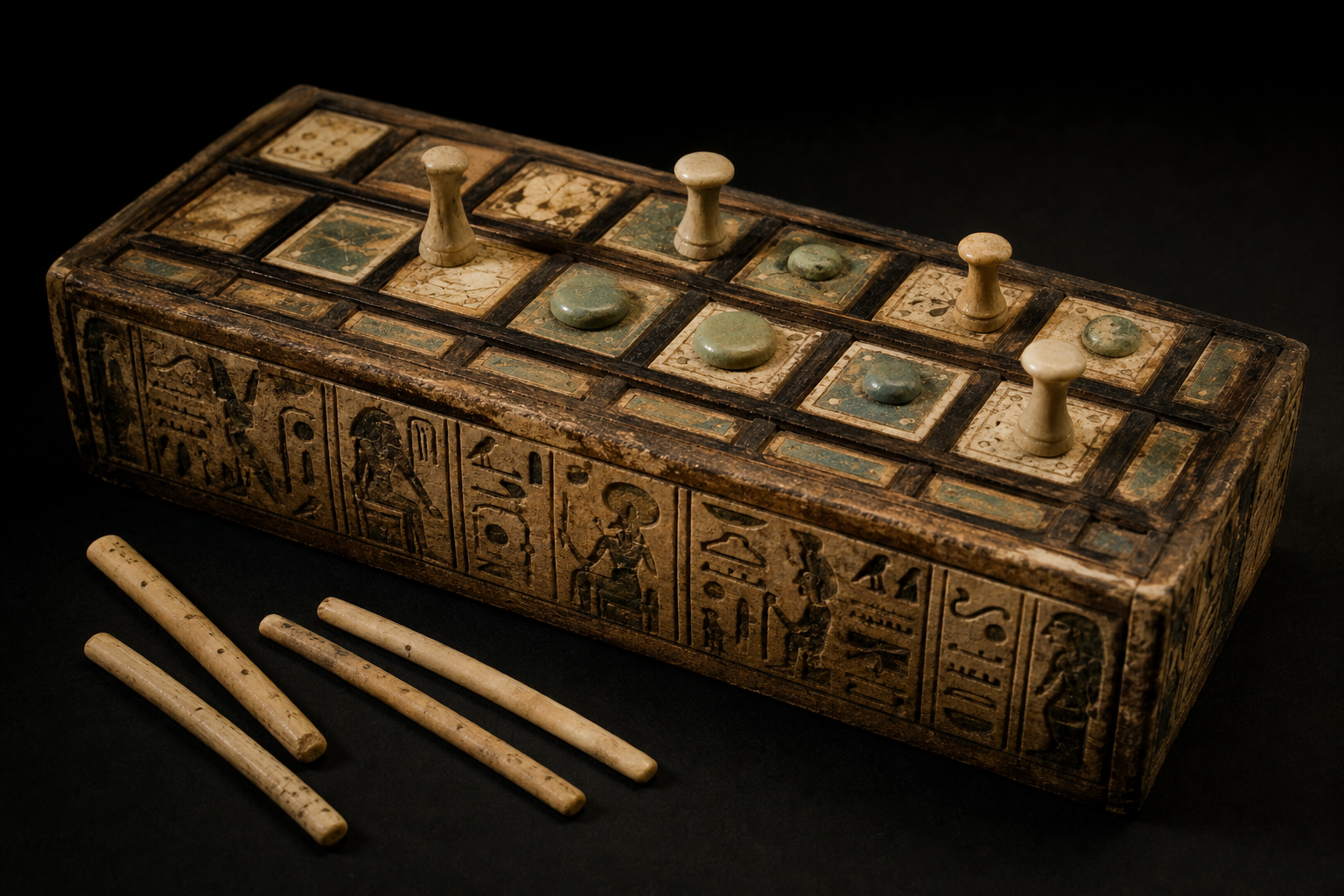
A senet board and its pieces, the kind of object families packed for a journey no living player would take.
Among the things Egyptian families tucked beside their dead, alongside food, jewelry, and the small carved servants meant to labor in the next world, excavators keep turning up something stranger and more familiar: game boards. Long boxes of wood and glazed faience, their surfaces ruled into thirty squares, sealed into the dark for a journey no living player would ever take. The most celebrated of them belonged to the boy king Tutankhamun, who was buried with at least four sets. But the habit was never reserved for royalty. Modest graves held boards too, and where wood was scarce a grid was simply scratched into a paving slab, to be played with pebbles and a handful of luck.
The game was called senet, from a word that meant “passing.” It is one of the oldest board games we can name, older than chess by thousands of years, older than the pyramids in its earliest forms. Two players moved their pieces along three rows of ten squares in a winding, back-and-forth path, and how far they moved was decided not by strategy alone but by the throw of four flat casting sticks or a set of knuckle bones. There was no cube of ivory pips yet. The dice of the Nile were split reeds that landed light side or dark side up, and the count they gave you was the count you were handed by forces outside yourself.
 The board that followed the dead
What began as an amusement drifted, over centuries, into something closer to scripture. By the New Kingdom the last five squares of the board carried special markings, hazards and safe harbors, and the game had been folded into the imagery of the afterlife. Chapter seventeen of the Book of the Dead shows the deceased seated at a senet board, playing against an unseen opponent for the right to pass into the fields beyond. Painted on the wall of Queen Nefertari's tomb, she plays alone, her rival invisible, the outcome standing in for the soul's whole case before the gods.
That is why the boards were buried. A senet set was not a keepsake so much as equipment, as necessary to the dead as a boat or a jar of grain. To win was to be justified, to advance square by square toward rebirth. To be blocked, sent back, or stranded was to fail a test that mattered more than any played in life. The everyday and the eternal sat on the same thirty squares, and the Egyptians seem not to have found that odd at all.
Chance as a form of prayer
It is worth pausing on what that arrangement assumed. The throw of the sticks was not noise to be corrected by skill. It was the voice of the gods speaking into the game, a verdict delivered one cast at a time. Fortune was not the enemy of meaning; it was the medium through which meaning arrived. When a player picked up the casting sticks, the gesture was closer to consulting an oracle than to what we would now call gambling. The uncertainty was the point. It was how the divine got a word in.
This is the sort of overlooked corner these research collections were assembled to notice, the places where a culture's deepest convictions hide inside its ordinary pastimes. The Egyptians did not separate play from belief, luck from law, the table from the temple. A game that we would shelve under leisure they packed for the one trip from which no traveler returns. If you want to understand what a people truly held sacred, the objects they could not bear to leave behind are a better guide than the monuments they built for show, a point the reference desk returns to often.
Where the gamble went
The boards fell silent eventually. Senet faded with the old religion that gave it weight, and the winding thirty-square path was forgotten so thoroughly that scholars had to reconstruct its rules from tomb paintings and educated guesswork. Yet the impulse behind it never went anywhere. Strip away the funerary meaning and what remains is a very old human wager: the willingness to hand a decision to chance and to feel, in that surrender, a brush with something larger than ourselves.
You can trace a straight line from Nefertari's casting sticks to the games of chance that fill our own age, where the wheels and cards and screens have shed every trace of prayer but kept the thrill of the unknown throw. The stakes are earthly now, and the modern landscape is a commercial one, mapped out in guides to the best online casinos in Canada such as https://www.thestar.com/entertainment/casino/best-online-casinos-in-canada/article_48974d21-f1aa-4565-88cf-629b6a4c4f55.html rather than in chapters of the Book of the Dead. The god has left the machine. What lingers is the gesture, the same lean toward the falling sticks, the same held breath while the count is decided by something we do not control.
The Egyptians would likely have understood that lean better than we do. For them the game was never really about winning a box of squares. It was a rehearsal for the one crossing that could not be practiced, a way of befriending chance long before it came for them in earnest. The boards in the museums, quiet now behind their glass, still hold the shape of that old bargain. For a fuller account of how senet was played and what it meant to the people who carried it into the dark, the Metropolitan Museum of Art keeps an excellent study of Egyptian board games in its collection. What the Egyptians took to their graves, it turns out, was not an escape from the world but a small model of it, thirty squares wide, with the future left deliberately, reverently, up for grabs.